The Honest Truth About Asphalt Maintenance: Does Sealcoating Really Prevent Cracks in The Treasure Valley?
Living in Idaho means dealing with serious weather extremes. We get scorching triple-digit heat waves in July and freezing, snow-packed weeks in January. If you own a home or manage a commercial property in Boise, Meridian, Nampa, or anywhere nearby, you know this climate is incredibly tough on exterior surfaces—especially your asphalt.
One of the most common questions we hear from property owners looking at their fading driveways or parking lots is: does sealcoating really prevent cracks in the Treasure Valley?
It is a fair question. Nobody wants to spend money on routine maintenance if it is just a cosmetic paint job. The short answer is yes, but it is important to understand exactly how the process works so you know what you are paying for and what to expect.
The Science of Asphalt Failure
To understand how a sealcoat protects your pavement, you first need to understand why asphalt breaks down in the first place.
Asphalt is inherently a porous material. When it is first laid down by a paving crew, the liquid asphalt cement acts as a heavy-duty glue, holding the sand and aggregate rocks together tightly. It is highly flexible and pitch black.
But over time, two main environmental enemies attack it: the sun and moisture. The intense UV rays we experience during an Idaho summer oxidize the asphalt, effectively drying out the essential oils that keep the pavement flexible. You can actually see this chemical process happening when your asphalt turns from a rich, dark black to a faded, dull gray. As it dries out, it loses its flexibility and becomes brittle.
Then comes the water. When it rains, or when the winter snow begins to melt, water seeps into those dry, porous surfaces. If that trapped water freezes overnight—which happens constantly during a Treasure Valley winter—it expands. That physical expansion pushes the pavement apart from the inside out, literally tearing the aggregate apart and creating a crack.
How Sealcoating Fights Back
Think of sealcoating as a heavy-duty combination of SPF 50 sunscreen and a waterproof raincoat for your pavement. It is a protective liquid emulsion applied directly over the surface of the asphalt.
When a high-quality sealcoat is applied, it replenishes some of those surface oils and creates a tough, impenetrable layer. It blocks the UV rays from baking the life out of the asphalt beneath it, which stops the oxidation process in its tracks. More importantly, it seals up the microscopic pores in the surface, forcing rainwater, melting snow, and even harmful vehicle leaks like motor oil and gasoline to run off rather than soak in.
By keeping the water out of the pavement matrix, you eliminate the freeze-thaw expansion cycle that physically breaks the asphalt apart. So, by tackling the root causes—sun damage and water penetration—sealcoating is your primary, most effective defense against new cracks forming.
The Honest Truth About Existing Cracks
Here is where we need to be completely realistic as industry professionals: sealcoating is a preventative maintenance measure, not a structural cure.
If you already have a jagged, half-inch crack running down the middle of your commercial parking lot, a thin layer of sealcoat is not going to magically glue it back together. Sealcoat liquid is designed to spread thinly across a flat surface; it does not have the structural integrity to bridge wide gaps or hold broken pieces of asphalt together.
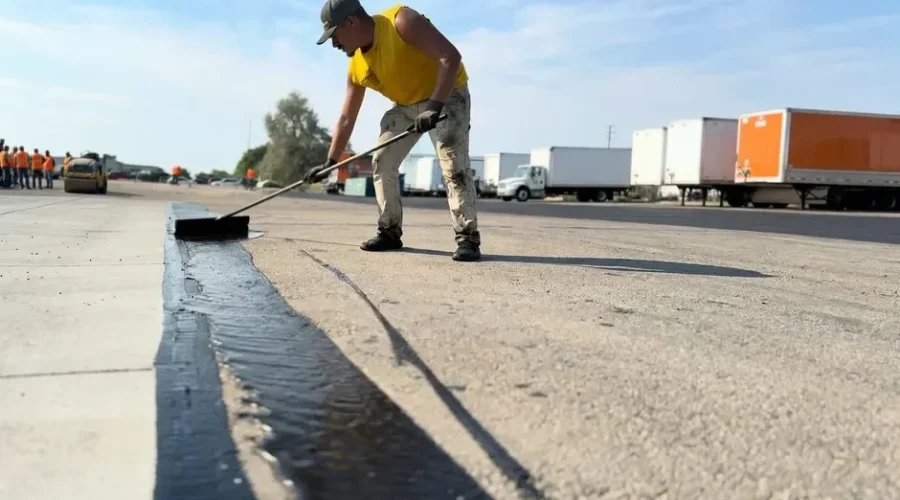
If you just sealcoat over an open, unsealed crack, it might look black and uniform for a few weeks, but water will inevitably still get inside, and the crack will continue to spread beneath the surface. The correct, professional approach in this scenario is hot rubberized crack filling. Boiling hot rubber is injected directly into the fissure to seal it watertight from the bottom up, remaining flexible enough to allow the pavement to expand and contract with the seasons.
Once the existing cracks are properly routed, cleaned, and filled, then you apply the sealcoat over the entire surface to prevent the next batch of cracks from ever starting.
The Local Timeline
Because of our specific, high-desert climate here in Idaho, a “one and done” approach simply doesn’t work. The protective barrier naturally wears down over time due to weather exposure, harsh snowplows, and daily vehicle traffic.
For most residential driveways and commercial parking lots in the Treasure Valley, a professional sealcoating application should be scheduled every two to three years. Waiting until the asphalt is already gray, brittle, and crumbling means you have waited too long, and you will likely be looking at costly structural patching or a full repaving job instead of affordable, simple maintenance.
Reopening the surface too soon
The Best Way to Prevent Cracks in The Treasure Valley
Don’t wait for the weather to destroy your pavement. We provide high-quality sealcoating designed to prevent cracks and keep your asphalt looking like new despite Idaho’s harsh seasons.